
The future did not actually look very bright to most Americans in 1934. Way too many people were out of work, and the country was dependent upon a volatile economy that was flickering like lamps in a thunderstorm, hoping desperately that the power didn’t go out.
Prospects were dim at best, and it seemed entirely likely that the nation might go dark.
So, Westinghouse considered it a moral obligation to show America a future. To give people something to dream.
To use their electrical genius to light a way to tomorrow.
The Westinghouse factory complex down by the tracks operated as a magnetic force—like a powerful dynamo—that drew to Mansfield some of the most brilliantly creative minds in the world to advance the electrification of human destiny.
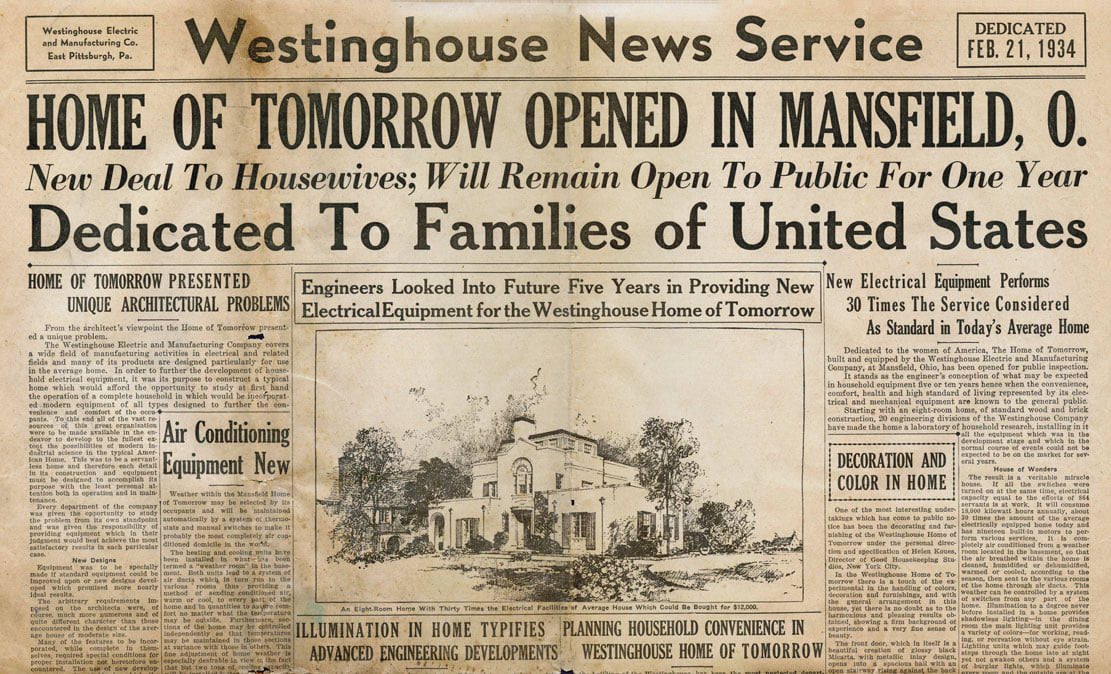
In 1934, that dynamic team of visionaries made their most cutting-edge technology leap off the drawing board and onto Andover Road so people could touch it, walk through it, see the future lit up.
It was called the Home of Tomorrow.
Also, the Home of Tomorrow was open to visitors at the same time as the World’s Fair in Chicago, and Mansfield was on the route toward, or on the way back from the Fair, for the greatest percentage of America’s population driving on the Lincoln Highway.
Into the Past to Find the Future
The Westinghouse Electric & Manufacturing Company had twenty Engineering Divisions across the country tasked with studying the future of housework, each from its own particular standpoint.
Their experimental house was literally Dedicated to the Housewives of America, and the electrical designers’ solutions were intended to eliminate “thousands of tiresome steps.”
The idea of the model home was to show how all these modern conveniences could be retro-fitted into common homes around America, so the streetview image was drawn so as not to be ultra-modernistic—like those exhibited at the Chicago World’s Fair—but instead, readily reminiscent of historic styles intrinsic to U.S. neighborhoods that anyone could find familiar.
Their masterpiece had eight rooms, was completely built in 82 days, and used more than three and a quarter miles of wire to turn the place on.
Good Housekeeping said it was “equipped as a servantless house,” and the engineers claimed, “If all the switches were turned on at the same time, the Home would employ electrical capacity equal to the efforts of 864 servants at work.”
The Christian Science Monitor called it the “First electrical home ever built.”


The Woodland neighborhood where the Westinghouse landmark rose was barely developed in 1934, and the site was ideally situated across the street from Mansfield’s picturesque sunken gardens.


Evident in the old picture, just right of the doorway, is “the doorman,” a revolutionary concept at the time which made it possible to talk with someone at the door from several locations in the house like the kitchen and the laundry. Thus eliminating “thousands of tiresome steps.”
Smart Home Technology of 1934:
The house where Tomorrow lived came equipped with the first ever portable radios—six of them. Every room in the house had a special antenna outlet the radios could be plugged into so that no family member ever need be without fresh media.


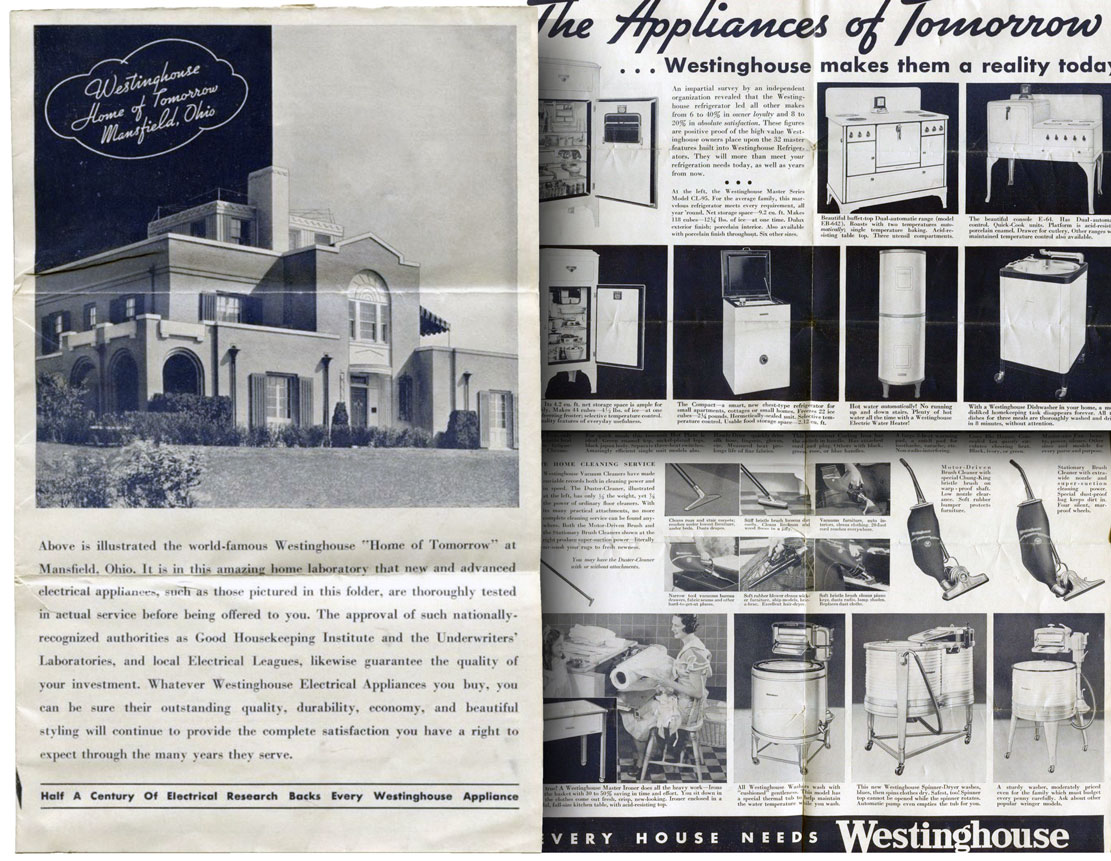
One of the most revolutionary ideas encountered at the Home of Tomorrow was the concept that any kitchen in America could have “an automatic dish-washer.”


“This unique, electrically equipped cart has sufficient space to contain all the food and dishes needed for a meal. Food is placed in the portable unit after being prepared in the kitchen and then is kept warm until ready to serve in the dining room.”
This promotional brochure went on to add, “An entire meal may be served without the necessity for one person to leave the table.”



Thank You!
Most of the images in this article were provided by Gene King (1934-1981)
Gene used to tell me stories about his father who worked at Westinghouse from the day it opened in 1918. He often remarked how amazing it was to him that I was so fascinated in hearing about things that took place decades before I was born. Then in 1981, Gene died suddenly. Last year, his niece, who never knew Gene at all and was born after he died, called to say that she had inherited a house, and in the attic there were boxes that had my name on them. And so, nearly forty years later Gene gave me all the things his father saved from Westinghouse.

 Richland County History
We have our parents house up for sale that is the exact house as this. He is so enjoyed growing up in this house
Here are the pictures of it: https://www.bhhsfosterrealtors.com/homes-for-sale/ky/309-main-street-irvine-40336/pid-402360705?LuxuryTheme=true
LikeLike