
Two boys, who grew up in Mansfield in different eras, developed a talent for drawing animals that make people smile; and they each took that art out into the world to touch the lives of millions of people.
I’d like to prove this now because I met a young man in Mansfield who told me that what he liked to do best is draw funny little animals; and it was a matter of some despair to him that there is no way to make a meaningful life out of that passion.
So, Shane, here is a moment of inspiration for you: so you can know that you are actually taking part in a fine old tradition of our town.

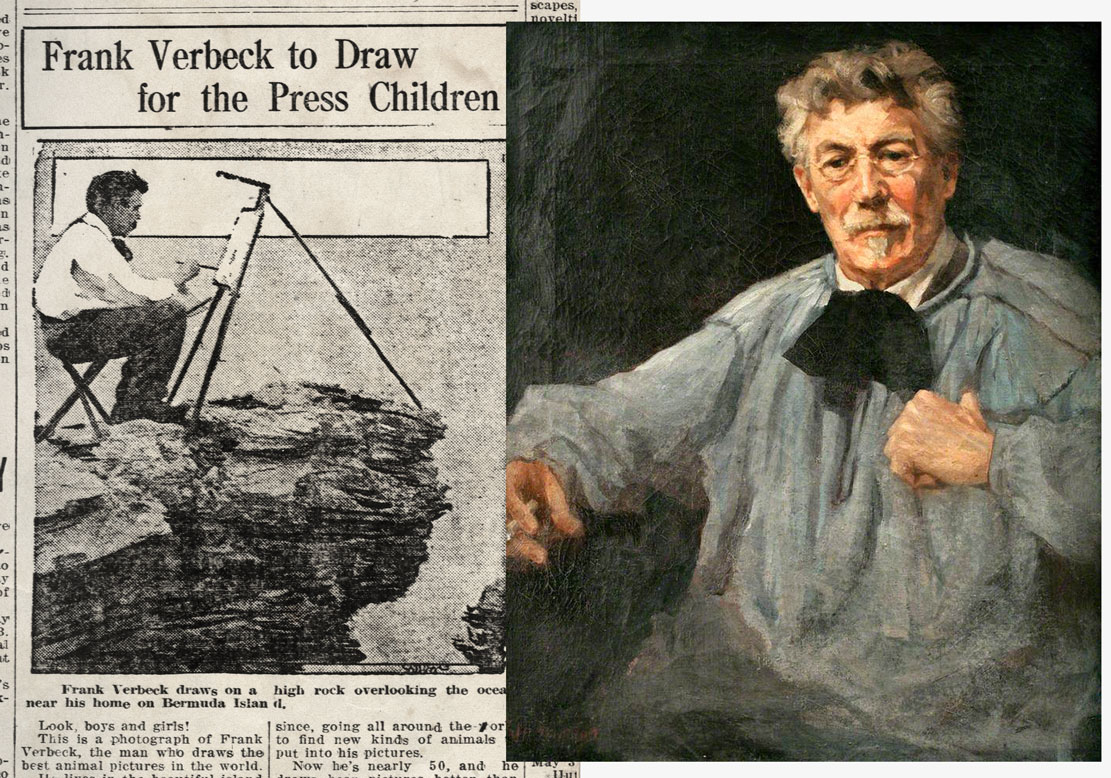
Frank VerBeck (1858-1933)
Frank VerBeck came to Mansfield as a schoolboy, when his family moved here in the 1870s. He was sketching critters—dogs, cats, mice, horses—from the time he was small; but the animals he became famous for were bears.
When he was interviewed in London in 1916, the reporter asked Frank when it was as a child that he had seen his first bear. Frank was 58 at the time; had drawn and published over 3,000 bears in magazines and illustrated books; and was recognized around the world for his distinctive style of portraying bears.
The reporter posited, “Your bears are so charming that I suppose you must have gone out in the woods and made many studies from life.”
“Sir,” replied VerBeck, “I have always lived in town. I never saw a live bear in my life.”


The only formal art instruction that Frank VerBeck ever had was in the Mansfield City Schools, and from a thoughtful old sign painter on North Main Street, who recognized a spark of genius in the young sketch artist, and undertook to teach him basic elements of design.
When frank was 23, he left for NYC, and it wasn’t long before folks in Mansfield started seeing his name on illustrations in nationally syndicated newspaper stories. By the turn of the century he was a regular contributor to major magazines like Collier’s and Ladies’ Home Journal; and in the first decade of the 20th century he had a whole shelf of illustrated books.
Frank VerBeck made quite a career around the world; living in New York, England and Bermuda. He never forgot Mansfield though, and came back to see his parents in Mansfield and sisters in Shelby.
He was a true celebrity whenever he walked into the Mansfield Library, and yet he always took time to read stories to the kids on the floor of the Children’s Room.


Frank VerBeck made a significant contribution to the illustration of classic American literature. He was chosen by L. Frank Baum to illustrate some of the Oz books in 1904-1908; and he was the first artist to interpret the Just So stories of Rudyard Kipling when they originally appeared serially in Ladies’ Home Journal.
Recognized as one of the greatest comic animal artists made him a natural to do the pictures for early editions of the Uncle Remus stories.

Some of his work from the early 20th century passed out of political correctness in recent decades, owing to the questionable stereotypes he portrayed during that era of racial insensitivity. Nonetheless, even his Little Black Sambo books bring high prices at auction.
Many of Frank VerBeck’s books are rare volumes today, yet he continues to charm collectors at any price. Those friendly bears can be hard to resist.

P.S.

 Richland County History