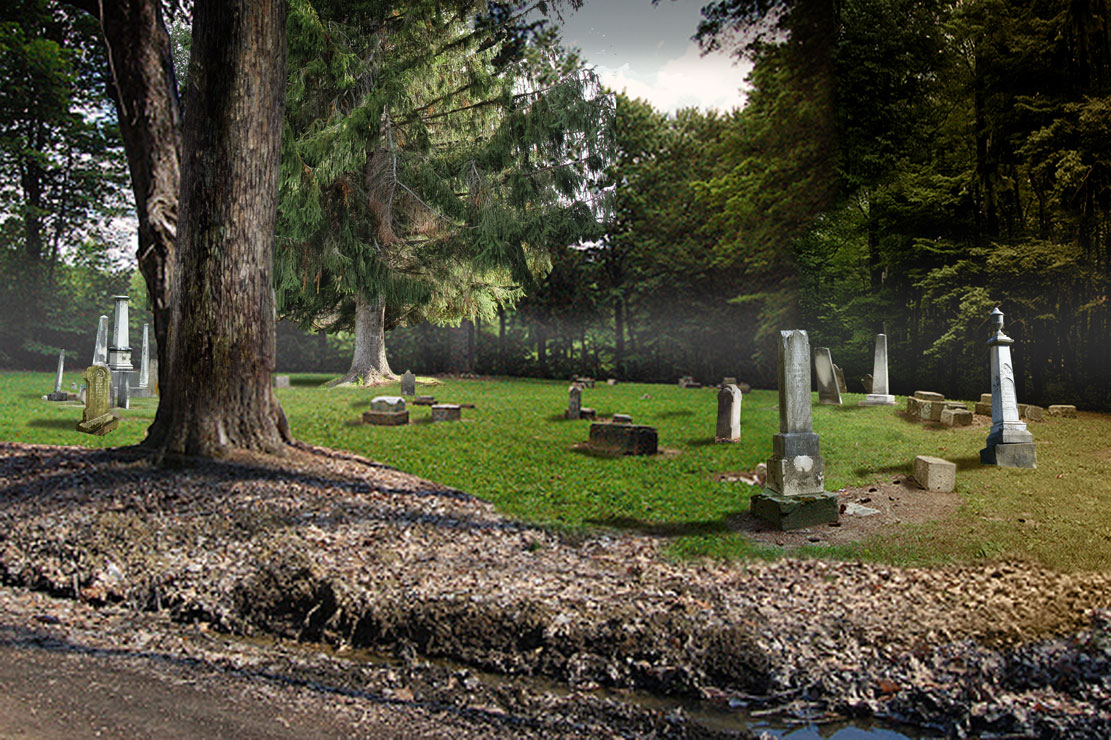
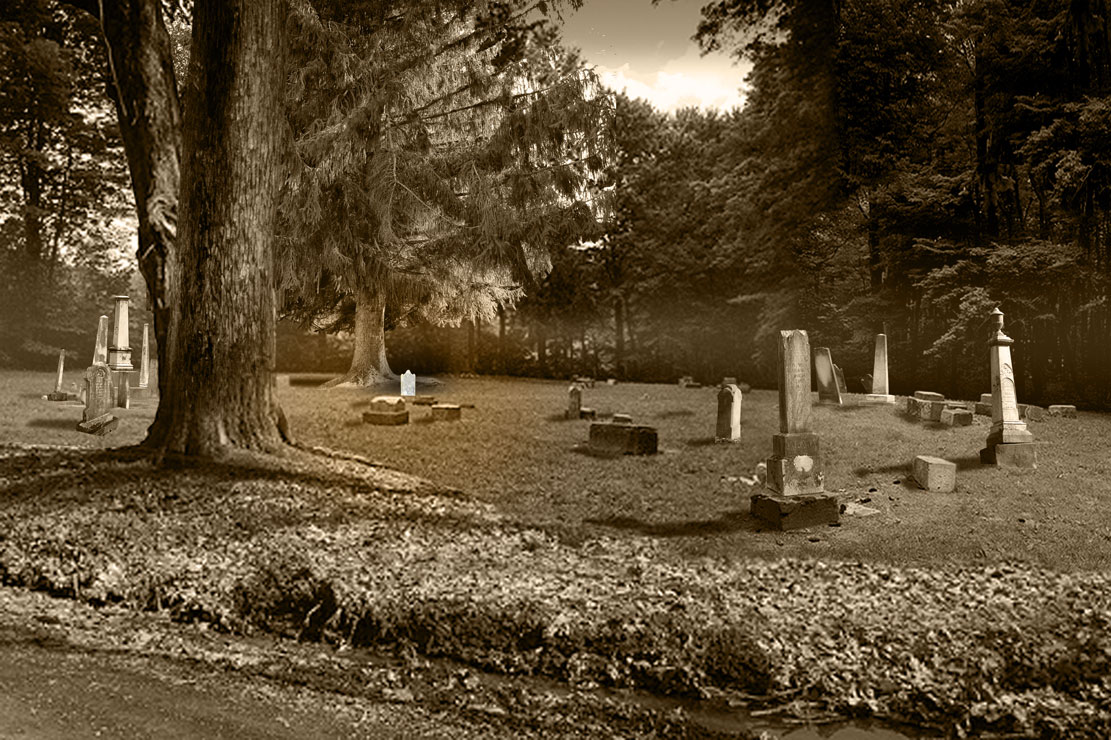
The end of an era came at Mary Jane’s Grave in the fall of 2014 when the huge and famous spruce that marked her resting place sadly crashed down among the stones. It might have been appropriate if the scarred old tree had been taken out by a fierce storm: there would have been a certain kind of poetry in that.
The history of her graveyard is much like a whirlwind that starts innocently enough as a summer breeze only to take on unexpected strength and gain unruly power to threaten the landscape as a raging and destructive twister.
If you picture a storm—dark and destructive and vaguely sinister—it is easy to impute this evil force as emanating from Mary Jane’s Grave; but if you do, then you also have to picture the eye of the storm: where all is peaceful, still and, comparatively speaking, rather boring. That’s actually an apt analogy of the story of Mary Jane’s Grave—because all the elements of the tale rage around the periphery, and the unfolding of the troubled history is all about everything except what’s at the very core: Mary Jane herself.
Because, she was most certainly not burned as a witch, nor did she take to her grave a life story any more malevolent than that which the trials of life bring to any other hapless soul in the graveyard. There isn’t a great deal known about her because there wasn’t hardly anything in her life to distinguish her from any other of the farm women of the Monroe Township countryside around Hastings. She was somebody’s sweet old aunt who died of cancer in 1898.

Mary Jane Hendrickson, one of nine children, had relatives in Hastings, and spent a large part of her life in the area as a maiden aunt. She was membered of the Evangelical Association, and passed away quietly from the effects of cancer.
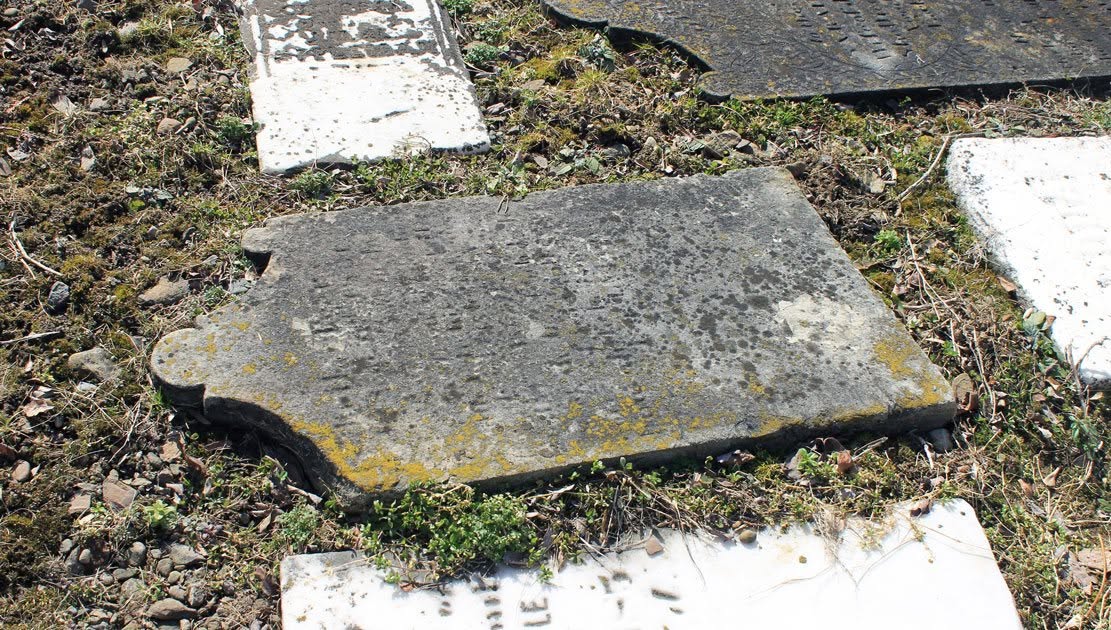
Her headstone, long since disappeared, read:
Mary Jane Hendrickson
March 3, 1898, aged 72 y 5 m 1 d.
The Seed
The only reason the tremendously dark aura coalesced about her name is because in the summer of 1960 a camp counselor at Hidden Hollow Camp nearby looked around the graveyard for a stone upon which to hang a story, and chose the humble headstone under a big old spruce marked Mary Jane as a suitable landmark for a witch story, to give young campers the creeps.
The fictional campfire tale recounted at Hidden Hollow told of Mary Jane abusing her evil powers until the neighbors finally rose up against her and hung her in the cemetery from a mighty pine. The tale concluded with a cautionary curse intended to protect the tree and her grave from mischievous trespassers.
It all began so simply, as harmless fun for a Halloween-in-July theme day activity, when kids took a spooky hike through the nighttime forest to a haunted graveyard. It was so popular, the spook hike became a yearly, and then a weekly event at camp for thousands of youngsters through the ensuing decades.
Who could have imagined in 1960 what the seed of that party-game would sprout into by the ’70s, and what a bizarre, thorny and poisonous vine would emerge through the 2000s to choke the life out of a once-lovely peaceful country bone yard.

Their annual Halloween-in-July activities originated at the camp’s first location, today Happy Hollow Camp on Hull Road. There was no cemetery at the original site, so they improvised (as reported in this column from 1953.)
Once the camp had an actual graveyard on its premises, a likely headstone was selected for a ghost story about a witch, and Mary Jane’s Grave began its strange rise to fame.
The Weed
The legend sprouted roots almost immediately. Youngsters from the youth camp grew up to be teenagers in their parents’ cars, and they all knew that a dead-end road was a perfect hangout for smoking dope in the hazy drug-blurred days of the ’60s-’70s.
The popularity of Mary Jane’s grave blossomed in no small part because the term “Mary Jane” was a hippie era code word for marijuana. The cemetery was profoundly isolated at the dead end of Tucker Road, and ideal for nefarious activities because there was only one way in and you could see headlights coming if the Sheriff was on his way.
The rowdy high schoolers were often drunk and stoned when they left the grave yard at midnight, and the shadowy rumors about the place grew darker and scarier when a car full of teens crashed tragically on Possum Run Road. Once the funeral was over it was rumored that the victim had, just minutes before his death, pissed on Mary Jane’s Grave.
It was well known in several counties that Mary Jane’s Grave was the place where you took your friends on a stormy night to scare them, and it was where you could park your girlfriend’s car and be pretty certain there weren’t going to be any witnesses. The forest at the dead end road often echoed with laughter, cheering, calls and shrieks. Some minor mishaps took place there in the next dozen years, but because the cemetery was so old it wasn’t certain if the headstones toppled over from gravity or if someone purposefully pushed them over.
It wasn’t until the turn of the century that the wild winds of evil really picked up velocity and hit a category-5 destructive force. Kids who went to Mary Jane’s Grave in the 21st century took their outsized teenage angst and rage with them, and afterward it looked like the place had been the site of an atomic detonation where every piece of gravestone more than a foot high was leveled, shattered and laid flat.

The Gnarly Trunk
As the story got handed off to new generations of teenagers, poor sweet old Mary Jane’s biography twisted farther and farther out of shape, until the story the kids heard had the old witch burned at the stake and laying a curse on the righteous with her dying screech. This, of course, only served to make angry teens identify with her outrage in such a way as to allow them to act more outrageously.
Since the ’80s no one really knew where her grave actually was anymore because the stone was long gone. Legend persisted that she was laid to rest under the pine tree so that’s where the séances were held, and a weird little altar of black embers and curious amulets came to mark the spot. The tree was emblazoned—sometimes with a cross, or alternately with some cryptic arcane symbols—either to fend off evil spirits contained within, or perhaps to embolden them.
Ultimately someone set the tree on fire, and when its mossy bark was scorched black, the sight seemed only to make the place appear more desolate and post-apocalyptic: the end of the road, the valley of ashes, the blackened remains. Finally in 2014 the tree got chainsawed right through its weird graffiti, and crashed down to lay out among the graves.


In Memory
I went out to Mary Jane’s Grave not long ago to take a look at the latest of the indignities that the graveyard has endured. It was a bleak, dark day—entirely appropriate for the sad sight that I found: the storied pine laid flat, the glowering sky brutally exposed.
A quiet blanket of snow lay over the scene like a hushed comforter, a soothing white cover for things too awful to look upon, the soft touch of Mother Nature reclaiming her oft-broken world and setting all at peace.

After so many headstones were destroyed in the last 20 years, an effort was made to preserve the memory of those whose graves were no longer marked by carving them all onto a common stone, seen in foreground above.
Post Script:
So one morning about ten years ago I was standing in the coffee line passing time with a total stranger, and for some reason the conversation turned to Mary Jane’s Grave. I mentioned that I had seen her headstone after it disappeared from the graveyard, and this guy, who was older than me, became very animated because I was the only person he had met who could corroborate his story. Not only that, he knew the end of the story I never heard.
My part of the story took place not long out of high school one day, when there were a few of us idling in McConnell’s driveway waiting for a ride somewhere. I happened to notice that just inside the garage door there was a tombstone leaning against the wall. The twins rolled their eyes and said Mike had swiped it off Mary Jane’s Grave, and with that little prompting it was then easy to recognize it as the stone we had all seen underneath the huge spruce in the Tucker Road boneyard.
Turns out the guy in the coffee line was a friend of Mike’s, and he helped carry the stone out of the garage. Why they couldn’t return it to Mt. Olive Cemetery he didn’t say—either too embarrassed or too sober—but he remembered exactly where they took it. He described the little graveyard west of town, and said there was a corner of the lot where misplaced, unseated, age-worn and anonymous stones had been piled up through the years by whoever mowed the place.
So he left her stone leaning on the scrap pile.
I drove straight from the coffee shop to find that graveyard while it was still fresh in my mind.
Between the time Mary Jane’s stone was moved and the morning I went looking for it, had passed no less than 40 years. And during those decades someone had undertaken a little burial ground landscape design. There was no longer a pile of anonymous headstones. The pile had been artfully arranged out through the grass as a flagstone walkway.
Mary Jane’s headstone had not been easy to read back when it was under the huge spruce, but in its new placement it had become illegibly worn since it faced up into the weather and the bottoms of peoples’ shoes. Yet it still had mostly kept its easily identifiable turn-of-the-century design.