
Central Park in downtown Mansfield has seen twenty-two decades of public service. This is where we bought war bonds and enlisted Union soldiers. This is where we gathered, summoned by a brass cannon, to hear news of the great battles.
It has been the site of loud demonstrations by labor unions, and quiet memorial services with solemn bells. Johnny Appleseed stood on a stump here, and Miss Ohio yearly parades through the crowds and waves at the camera.
Through the years folks have come to Central Park for everything that makes a collection of people into a community, and makes news into history.
A 10-Minute History of Central Park :
Then & Now: Central Park west end 1899


Then & Now: The Square in the Snow 1913
A hundred years ago Central Park was much more wooded than it is in our time—not only shady in the summer, but also lovely after a snow.
If you look closely at the right side of both images you will see the same building still stands on Main Street across from the northwest corner of the Square.
Illuminated arches can be seen in this photo that marked the entrances to pathways through the park. These were miniature versions of the grand arches that spanned Main Street and major intersections at the Square.

Then & Now: Flagpole on the Square 1952
A couple generations ago, the Mansfield municipal flagpole was found on the western side of the Square, back when the Square was square.
In the last years of the 1950s, when the Square was modified into two rectangles, the site of the flagpole was reappropriated with asphalt into a turning lane and the civic landmark was moved into the lane divider.
It subsequently moved once again a few dozen yards east where it is found today near the fountain. Automated pole technology has made the use of Boy Scouts obsolete in the 21st century raising of our flag.

Then & Now: Memorial Cannon 1907
After the Civil War, when towns all over the country were petitioning Congress for old cannons to decorate their town squares, Mansfield was given four huge cast iron beauties that weighed 8,500 pounds apiece designed for coastal defense.
Their original configuration was in the form of an odd pyramidal balancing act that was known as the Gun Monument until it fell down.

Then the four guns were mounted to protect the four corners of the Square, each with a small pile of cannon balls ready at hand.

When the new courthouse was built on Diamond Street in the early ’70s, the cannon were moved to their present mounts in the courthouse lawn where they defend the front porch.

Then & Now: Mansfield Fire Bell 1958
When the fire bell was first mounted into the high tower above Mansfield Fire Department Station #1, the town was small enough and the world was quiet enough that when the bell rang out specific codes for various areas of the city anyone could hear it and know what was going on where.
Betty Angle grew up on Vennum Avenue—nearly a mile from the bell—and she said when the bell rang her father rushed out of the house with his camera and could always tell by the number and sequence of tolls exactly where to go to catch the action. That was in 1916.
The bell tower rose high above the Fire Station in the front of the Municipal Building at the corner of S. Walnut and Park Avenue West. When a new City Building was built down Walnut Street in 1924 the bell wasn’t needed any more, so the tower was demolished and the bell took up residence on the northeast corner of the Square.


The approximate position of the old Fire Bell is marked today by a Mansfield Fire Department monument in memory of Firefighters Past, Present & Future.
The Fire Bell itself moved off the Square in 1993 when the Mansfield Fire Museum opened on West Fourth Street.

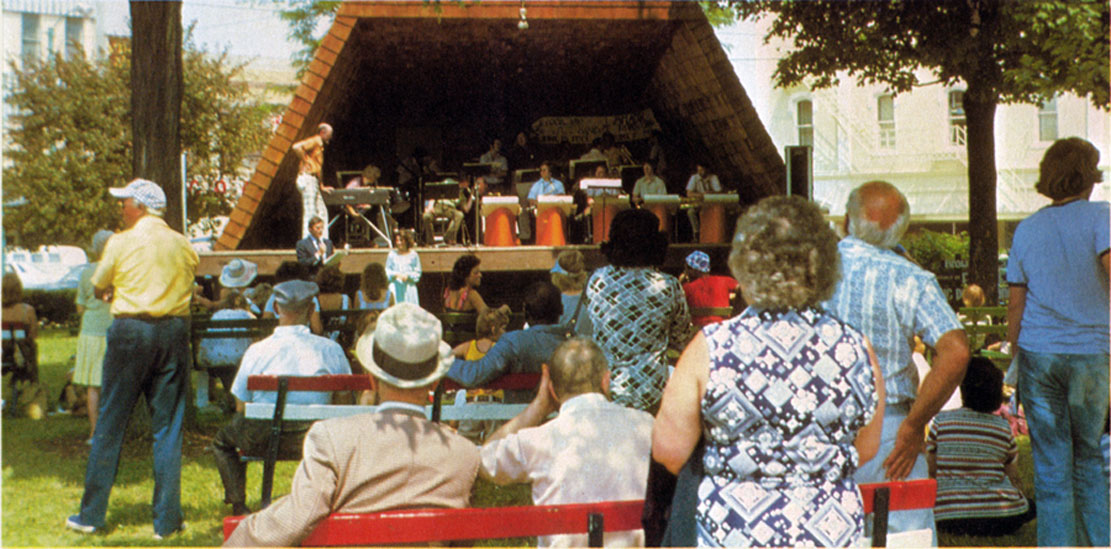
Then & Now: Mansfield Bandstand
The bandstand in Central Park on the Square in Mansfield witnessed more than 80 years of all the things that went on in the heart of town, and a thousand speeches with every point of view imaginable—including one by a sitting U.S. President in 1912.


Built in 1878, the civic podium lasted until 1956, having gone to pieces due to weather and termites. It took another 40 years, but the city finally built a new public stage to stand in the Square: this time made of steel.
Easily the most democratic of our public venues, the bandstand in Central Park has always been open as a platform to anyone who has anything they want to speak out to the world.

Then & Now: WWI Soldier 1957
There are a couple of old diehard soldiers who have been standing watch over the Square in Mansfield for a long time. One of them is the infantryman from World War I who came to town in 1922 to memorialize Richland County boys who fought in the Great War.
Originally this Doughboy stood on the east side of the Square and his gaze was cast toward the rising sun down Park Avenue East.

In 1959, the road was cut through the Square right under his feet, so he was repositioned facing his old friend of many years: the Civil War soldier.
When this WWI enlisted man first came to town at the invitation of the Daughters of the American Revolution, he was made of Italian marble and appeared bright white even when it wasn’t snowing. Some years after he moved 50 yards west he was cast in bronze to better withstand the Richland County winters.

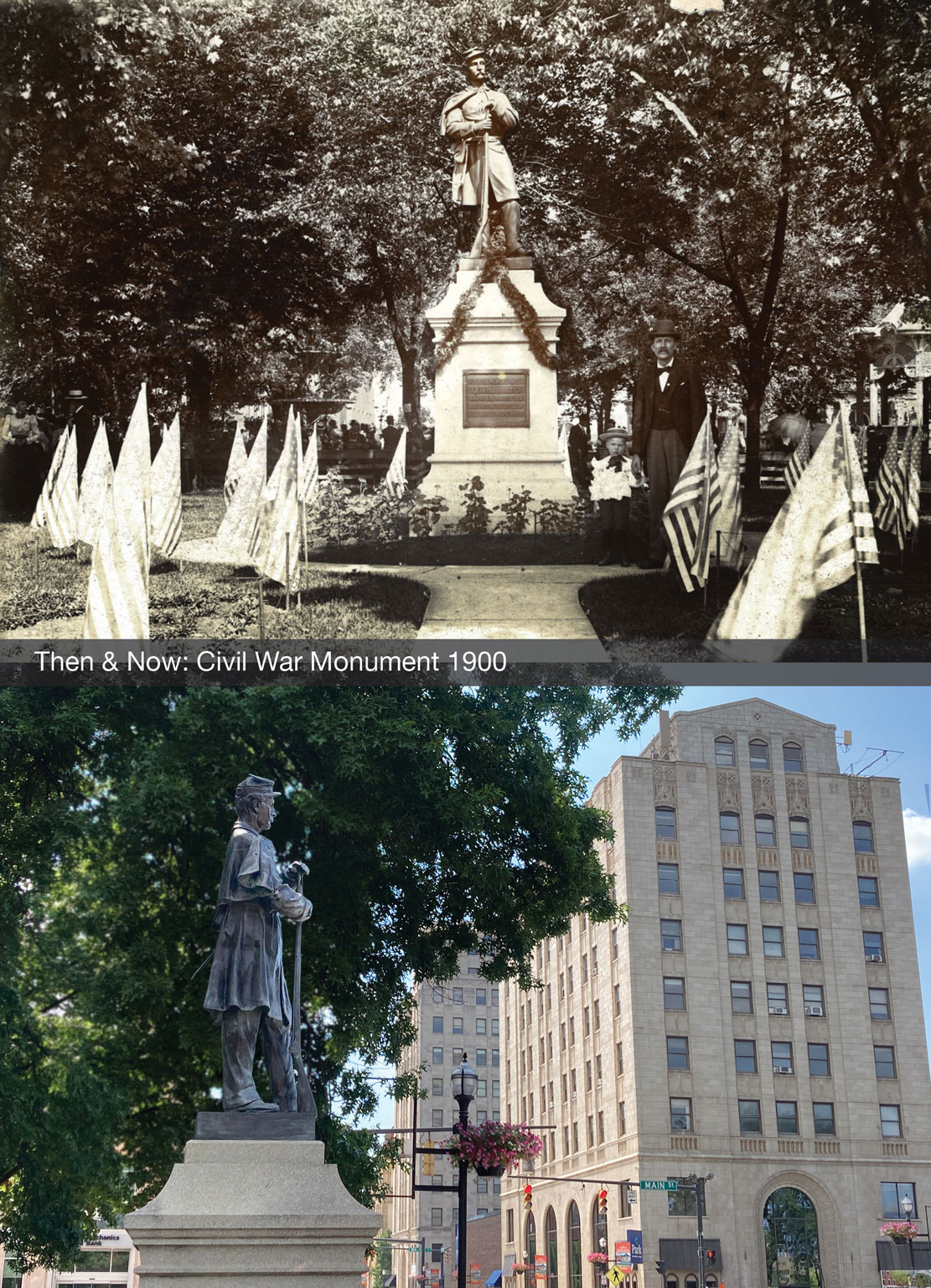
Then & Now: Civil War Monument 1900
When the Soldier’s Monument was placed in Mansfield in 1881, the road he was stationed to watch was called Market Street. In the same year, a new civic park was dedicated out in the west end of town where he faced, so it seemed appropriate to rename that main east-west thoroughfare as Park Avenue.

The original Union Soldier statue was made of lead, and when he was moved in 1959 to make room for 20th century traffic, the old guy crumbled. He was recast in bronze to stand watch from a new post, and rededicated in 1998.
Then & Now: Vasbinder Fountain 1913
When it was dedicated on the Fourth of July in 1881, the public fountain rose in the exact center of the Square as a life-giving heart of the city. Donated by, and named for the Vasbinder sister and brother, the fountain was exiled from town in 1959 when Park Avenue was cut through the public ground. Since it was restored to Central Park in 1978, it occupies a site close to where the original bandstand once stood.

Post Script on the Fountain:

Most of those old postcards you find from the early 1900s were cheap ripoffs that drugstores copied from popular photos, and in the process of reprinting a great deal of detail is lost. I’ve seen this particular image in charming lithographed copies many times but this is the first chance I ever had to scan the original photo. The detail is amazing. All of those men lurking in the background aren’t anonymous shadows anymore, but real folks with scowling faces.
But most amazing of all is the face I never knew was there:


Then & Now: Central Park Cut Through 1959
The Public Square of Central Park remained inviolate for 107 years until 1959 when the memorial soldier monuments were shoved aside, and the fountain was ripped out, so Park Avenue could cut through the heart of town.

Now & Someday:
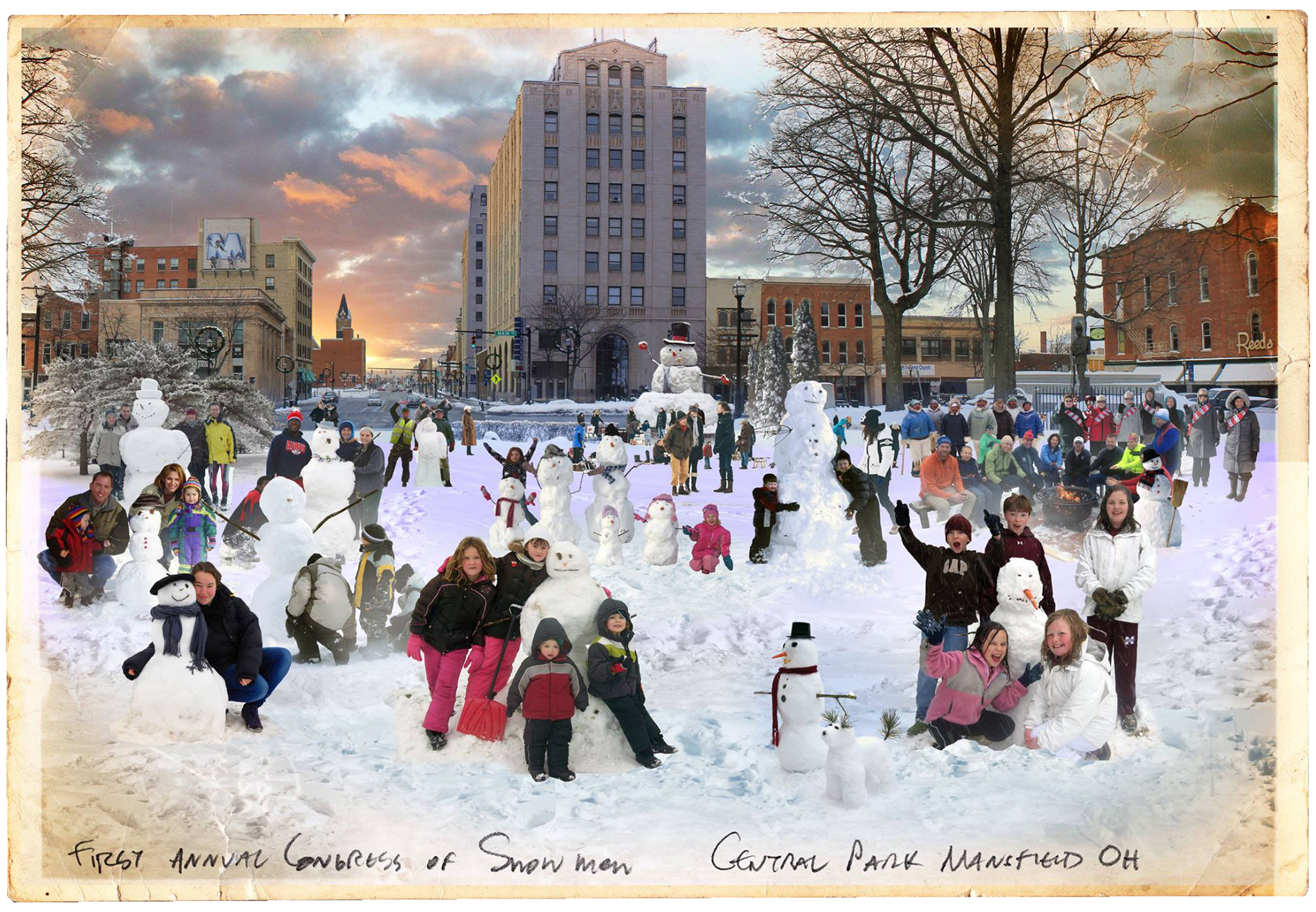
Three generations have known Central Park as a pair of wide rectangular traffic berms separated by cars and pavement.
It is only a question of time until a generation of Mansfielders rises with the clarity of vision to recognize that our public commons is called The Square because it was always intended to be Square.
This image of families enjoying the heart of Mansfield slips through time to us from that healthier day to come.
The Sacred Space
In the language of ancient Iran, it was the word for ‘an enclosed park;’ and then, perpetuated and translated through Greek, Latin, Old French and Old English it became our word: Paradise.
From the midnight roof of Richland Trust, Central Park is certainly an enclosed arboreal garden.

Thank You
Images in this article come from many sources, including the Mark Hertzler Collection, Richland County Chapter Ohio Genealogical Society, Phil Stoodt, Bob Carter, Charles Weaver, Troop 118, Eileen Wolford, Virgil Hess, Ray C. Smith, and Marge Graham.
Post Script: Veteran’s Day Sometime in the Future

 Richland County History
Nice article about the square. I lived in the Mansfield area, first at the Cook Rd apartments and later in Lexington from June 1980 until summer of 1984. I had worked at the Ohio Brass Company then.
I remember a few events there, once on a National Holiday an Army Chopper flew in. It may have been Memorial Day or Independence Day on of those years.
Thanks for the article and the accompanying photos.Mark Fields
LikeLike